From the Classroom to Real Life: Creating Lifelong First Aid Responders
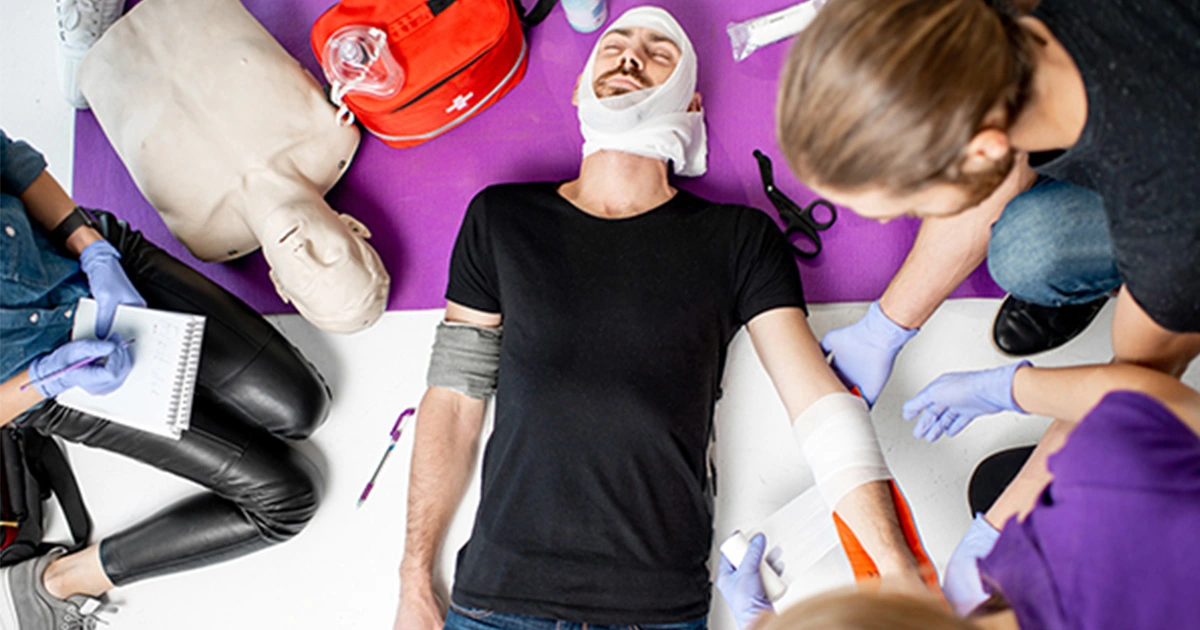
When studies look at whether initial care was provided by citizens (friends, family, co-workers, or simply people in the right place at the right time), that care in the minutes before a 9-1-1 response can be lifesaving. Often, those who step up are off-duty medical professionals, emergency services providers, or people who took a standard first aid course at some point in their lives.
After teaching First Aid and EMS courses for the past five decades, I have always tried to encourage students to become lifelong providers. Not every student will make a career out of EMS or Emergency Services, but I would hope the First Aid skills they learned became lifelong skills. Procedures do change, and those who respond professionally need to stay current. But when someone who once took a FA course finds themselves facing an injury or medical emergency, I hope they step up as a Good Samaritan and provide initial assessment and First Aid while waiting for professionals to arrive.
The concept of the Good Samaritan is mentioned in the legal section of most EMS books as a form of legal protection encouraging those with some training to help without expectation of renumeration for their services.
Standard FA training, and higher levels of training, should support assessment and decision-making skills. Students may someday find themselves at a multiple-car crash or stuck in an elevator with someone experiencing a diabetic emergency. Knowing the first steps in FA, including how and when to call 9-1-1, can be critical, especially when too many people pull out their phones to record instead of calling for help.
So, what lifelong FA skills should every citizen and off-duty EMS provider be ready to use?
Starting Training Early
At a minimum, I would advocate teaching everyone, beginning in grade school, the core skills of scene safety, how and when to call 9-1-1, bleeding control, CPR, public access AED use, choking response, Narcan use when opioid overdose is suspected, basic burn care, and how safety devices such as seat belts, car seats, helmets, and safety glasses can prevent injuries.
Jr./Sr. high school would also be an appropriate time to offer every student standard FA training. Many schools already teach CPR and expanding that training could spark interest in EMS or emergency services, or at least help students carry practical FA skills with them for life. Some high schools are already offering EMT training.
Making it Relevant: It all Starts with Stories
I believe that teaching First Aid (FA) is easier for the Instructor when teaching students who can personally relate to many situations where the FA skills will be needed. Some students come to you with experiences that they may have already replayed in their mind over and over and wondered “if they only knew what to do” when grampa collapsed at home, or their brother was hit by a car riding his bike.
For those students who do not come to your class with tragic experiences and the intrinsic need to learn FA skills, it is our job to share realistic stories so they can visualize themselves using the skills!
Most Instructors have experiences they can draw upon to share with students. Take the time to practice telling the story (what, where, how, when, why) in an interesting yet succent manner which introduces a specific topic or highlight the specific care they will be learning in the course. Keep the personal names out of the story and remember the age and backgrounds of your audience.
Next, I would like to give a couple of examples of my own stories; obviously yours will work better when you are teaching!
First Aid Case #1
My wife, Kirt, also a medic, and I were flying home to Albany, NY from the Chicago Marathon with a layover in Baltimore when a PA announcement asked for a doctor. When no one responded, we told the flight attendant we were paramedics from New York. She brought us to a 65-year-old man with chest pain and heavy sweating for about 40 minutes. He had a history of similar symptoms, but his nitro was in his checked luggage. Kirt returned with the plane’s FA kit, including oxygen, an AED, and a BP cuff. We took vitals, gathered a SAMPLE history, and found aspirin from another passenger for him to chew.
Another passenger then identified himself as a doctor, though we later learned he was a podiatrist. After giving him a report, we discussed nitro since the patient’s BP was high and he was a good candidate. Another passenger had nitro, the doctor checked it, and we administered it while continuing to monitor vitals. After two nitros and some oxygen, the patient’s pain improved. Kirt contacted the airline’s medical command while I stayed with the patient. Since we were more than an hour into the flight and he was improving, we recommended continuing to Baltimore with a cleared path. We landed about 30 minutes early, gave report to the Baltimore paramedics, provided written information to the flight attendant, and later received a nice thank-you note.
Issues to Ponder: Very limited FA equipment on airplanes. As Good Samaritans, we did not expect any renumeration for our assistance. We did try to keep within the scope of an EMT which was national during those years. It did make us wonder what challenges would have occurred had the patient went unconscious and/or into cardiac arrest on the plane!
First Aid Case #2
We were having a nice night out at a favorite restaurant when I got up to go to the restroom and noticed commotion in a back party room. A group of about 20 customers had crowded around a makeshift conference table made from plywood on top of smaller tables. After the meal, a waitress hurried in with a large sharp knife to cut the cake, nearly ran into a patron, tripped, and stabbed the knife into her brachial artery.
A well-meaning intoxicated patron decided she needed to lie down, picked her up, and plopped her onto the table—which split in half, sending plates, glasses, and cake everywhere. My first thought walking in was, “What the heck kind of party was this?” After making sure 9-1-1 was called, introducing myself as a local paramedic, and getting help from a less intoxicated patron, we identified the bleeding site. Of course, someone had already pulled out the impaled knife. We applied direct pressure with a towel and cleared some confusion from the room, and by the time the local ambulance crew arrived, the waitress was doing much better. Looking back, once it was clear she was okay and transported promptly to the ED, it was all a bit comical. Hopefully the restaurant stopped crowding that room, building makeshift tables, and neglecting the first aid kit.
Issues to Ponder: The restaurant’s first aid kit had only a few bandages and a pocket mask, but a clean towel worked fine. Crowd control and noise were the initial challenges, but once the room was mostly cleared, it was easier to confirm there was only one bleeding site. If I had arrived a minute or two sooner, I might have stopped the well-meaning patron from pulling out the impaled object.
First Aid Case #3
On a warm holiday weekend, a neighbor apparently discovered too late that his barbecue propane tank was empty. He found some old charcoal and lighter fluid in the garage, but after waiting impatiently for the fire to start, he decided to pour lawnmower gasoline onto the coals. A couple of coals must have been burning, because the gasoline fumes flashed and caught him on fire. When I heard the screaming and got there, it was clear the stop, drop, and roll drill had not been remembered. Fortunately, a garden hose was nearby, so we hosed him down, put out the fire, and made sure someone had called 9-1-1.
By the time the fire department arrived, the fire was out, but the 22-year-old patient, stripped down to his undershorts, was in a lot of pain. He had partial-thickness burns to his chest and parts of his arms, though his face was spared, probably because he threw his arms up in front of it. The EMTs placed a sterile burn sheet on the stretcher while the medic prepared pain medication and fluids for the trip to the trauma center.
Issues to Ponder: Having a hose nearby made a big difference. Gasoline fumes can flash into fire quickly, and this “exciting” barbecue could have been much worse if it had been followed by more drinking and backyard fireworks.
First Aid Case #4
At a local warehouse store, an employee apparently stacked large containers of powdered chlorine for backyard pools into a pyramid. A rushed customer cut a corner too tightly with a shopping cart, knocked over part of the display, and spilled white powder across the floor. Then an employee came over with a mop and bucket of water and started wet mopping the area—when a broom and dustpan would have been a better idea.
Needless to say, the chlorine fumes intensified and several customers started coughing. I was shopping for office supplies, noticed the smell, and helped an employee call 9-1-1 and set up chairs outside so EMS could evaluate anyone coughing. Many people were checked, but those closest to the spill and those with asthma, COPD, or other comorbidities needed the full workup. Meanwhile, the fire department cleaned up the chlorine and used large fans to air out the store.
Issues to Ponder: The first challenge was getting everyone outside to a safer area while sorting out who might truly be sick, who would likely be fine, and who wanted to be checked only because others were being checked. Store management was not thrilled about emptying the building, but once police arrived, they got the message. When the fire department arrived, there was enough help to search for any remaining customers or potential patients still shopping.
About the Author
Bob Elling, MPA, Paramedic (retired) – has been a career paramedic, educator, author, and EMS advocate for 5 decades. He was a paramedic with the Town of Colonie EMS Department, Albany Times Union Center, and Whiteface Mountain Medical Services. He was also an Albany Medical Center Clinical Instructor at the HVCC Paramedic Program. Bob served as AHA National/Regional Faculty and participated in many successful life-saving legislative campaigns with the You’re the Cure Network. He also served as paramedic and lieutenant for New York City EMS, a paramedic program director, and associate director of New York State EMS Bureau. He has authored hundreds of articles, videos, Blogs, and textbooks to prepare EMS providers for their career. Bob is the ECSI Series Editor for the CPR and First Aid books, Co-Author of EVOS-2, and Co-Lead Editor of Nancy Caroline’s Emergency Care in the Streets.
First Aid, CPR and AED Guide Ninth Edition
Designed for quick, portable access to vital first aid and basic life support information, this affordable 76‑page guide provides clear, trusted guidance for real‑world emergencies, everyday readiness, and refresher training.